Wednesday, December 16, 2009
Thursday, April 23, 2009
Simulated brain closer to thought
Published by Jason Palmer - BBC on 22/04/09
A detailed simulation of a small region of a brain built molecule by molecule has been constructed and has recreated experimental results from real brains. The "Blue Brain" has been put in a virtual body, and observing it gives the first indications of the molecular and neural basis of thought and memory. Scaling the simulation to the human brain is only a matter of money, says the project's head. The work was presented at the European Future Technologies meeting in Prague. The Blue Brain project launched in 2005 as the most ambitious brain simulation effort ever undertaken. While many computer simulations have attempted to code in "brain-like" computation or to mimic parts of the nervous systems and brains of a variety of animals, the Blue Brain project was conceived to reverse-engineer mammal brains from real laboratory data and to build up a computer model down to the level of the molecules that make them up. Click for more...
Posted by
Neuronion
at
13:54
0
comments
Friday, April 03, 2009
Robot scientist 'Adam' solves genetic problems
Posted by
Neuronion
at
09:10
0
comments
Wednesday, April 01, 2009
CADIE: April fools or not?
As you are reading these lines you have probably already read Google's April fools joke on CADIE (Cognitive Autoheuristic Distributed-Intelligence Entity), a self-conscious computer system. Good sense of humour you may say, or great imagination! But could this just be a fun way of introducing a new reality? Could Google be close to building the first self-conscious machine that passes the Turing test? What do you think? After all, if Google cannot make it who can?
Posted by
Neuronion
at
10:37
0
comments
Sunday, October 05, 2008
Intelligent computers put to the test
Published by The Observer on 05/10/2008
Can machines think? That was the question posed by the great mathematician Alan Turing. Half a century later six computers are about to converse with human interrogators in an experiment that will attempt to prove that the answer is yes. In the 'Turing test' a machine seeks to fool judges into believing that it could be human. The test is performed by conducting a text-based conversation on any subject. If the computer's responses are indistinguishable from those of a human, it has passed the Turing test and can be said to be 'thinking'. No machine has yet passed the test devised by Turing, who helped to crack German military codes during the Second World War. But at 9am next Sunday, six computer programs - 'artificial conversational entities' - will answer questions posed by human volunteers at the University of Reading in a bid to become the first recognised 'thinking' machine. If any program succeeds, it is likely to be hailed as the most significant breakthrough in artificial intelligence since the IBM supercomputer Deep Blue beat world chess champion Garry Kasparov in 1997. It could also raise profound questions about whether a computer has the potential to be 'conscious' - and if humans should have the 'right' to switch it off. Click here for more...
Posted by
Neuronion
at
19:28
0
comments
Wednesday, August 20, 2008
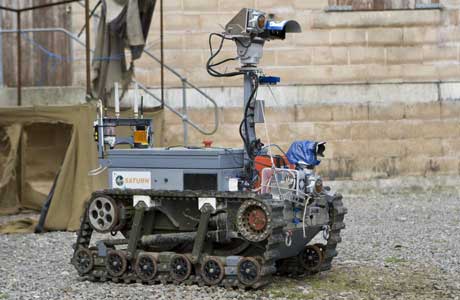
Team Stellar wins the MoD Grand Challenge
Published by The Guardian on 19/08/2008
The Grand Challenge winner, announced today, was Team Stellar – a collaboration of small firms, researchers from Cranfield University and large industrial manufacturers. It beat off competition from 10 other teams whose creations included a swarm of quadropters (helicopters with four rotors), a scaled-down JCB lookalike and a mini flying saucer. The strange collection of craft were taking part in an ambitious competition to develop uncrewed surveillance vehicles that can help the military identify enemy positions in a town or city before sending in troops. The MoD earmarked £4.5m to stage the contest and develop the technologies for the battlefield. The teams competed over three days at Copehill Down, a mocked-up German village on Salisbury Plain that the army uses for training soldiers in house-to-house fighting. Click here for more...
Posted by
Neuronion
at
16:58
0
comments
Friday, June 06, 2008
IBM's new 'human brain' supercomputer
IBM says next week will see the release of a successor to the world's fastest supercomputer Blue Gene, which it claims will have the calculating capability of the average human brain. The Blue Gene/P will be capable of operating at 'petascale' speeds (one quadrillion operations per second). This a significant jump in processing power from the previous version, the Blue Gene/L which was 'only' capable of terascale speeds (one trillion operations per second).The news was announced by Nicholas M. Donofrio, IBM's soon to be retired executive vice president for Innovation and Technology, at IBM's first European Information on Demand conference in the Netherlands. He was making a speech on how innovation and the ability to transform invention into products, services, methods, processes and policies was a vital part of business in the past, present and future. Click for more...
Posted by
Neuronion
at
08:28
0
comments
Friday, May 30, 2008
Computer model knows what you're thinking
A computer model has been developed that can predict what word you are thinking of. The model may help to resolve questions about how the brain processes words and language, and might even lead to techniques for decoding people’s thoughts. Researchers led by Tom Mitchell of Carnegie Mellon University in Pittsburgh, Pennsylvania, 'trained' a computer model to recognize the patterns of brain activity associated with 60 images, each of which represented a different noun, such as 'celery' or 'aeroplane'. The team started with the assumption that the brain processes words in terms of how they relate to movement and sensory information. Words such as 'hammer', for example, are known to cause movement-related areas of the brain to light up; on the other hand, the word 'castle' triggers activity in regions that process spatial information. Click for more...
Posted by
Neuronion
at
09:48
0
comments
Thursday, May 29, 2008
Free choice activates a decision circuit between frontal and parietal cortex
Published by Bijan Pesaran, Matthew J. Nelson & Richard A. Andersen on Nature journal (16/04/08)
Posted by
Neuronion
at
00:18
1 comments
Wednesday, May 28, 2008
Neuroscience: Brain control of a helping hand
Posted by
Neuronion
at
23:56
0
comments