Tuesday, March 16, 2010

Blind soldier 'sees' with his tongue

Published by The Engineer on 16/03/10

"A British serviceman who lost his sight while serving in Iraq is using the BrainPort vision device in order to ‘see’ with his tongue. The new system — known as the BrainPort vision device — was developed by the Centre for Vision Restoration for the US Armed Forces Institute of Regenerative Medicine (AFIRM) and is being trialled in the UK by retired Lance Corporal, Craig Lundberg, who served with 2nd Battalion The Duke of Lancaster’s Regiment. Lundberg was hit by a rocket-propelled grenade in March 2007 while he was serving in Basra. As a result of the explosion his left eye had to be removed and his right eye was severely damaged, leaving him profoundly blind". Click for more...

Monday, March 01, 2010

How does the brain learn to see?

"Pawan Sinha details his groundbreaking research into how the brain's visual system develops. Sinha and his team provide free vision-restoring treatment to children born blind, and then study how their brains learn to interpret visual data. The work offers insights into neuroscience, engineering and even autism."

[G.K. Comment: Life is like a pyramid. By grouping the small details available at every level of a pyramid, you reach the top. This is called abstraction. The way we learn is like a pyramid and this video proves how it works. Amazing! ]


Wednesday, December 16, 2009

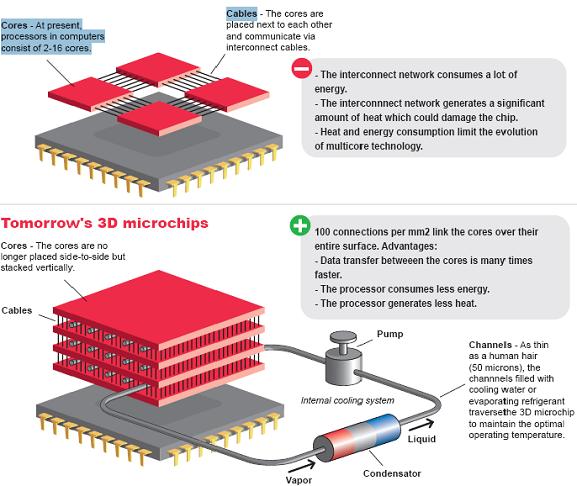
IBM, EPFL & ETH to build 3D brain-density processors

Published by The Register on 14/12/09

"Boffins in Switzerland have warned that increasingly powerful computer processors are set to guzzle the entire world electricity supply by the year 2100. They say that only 3D myria-core chips can save the day." Click for more...

Is quantum computing the future of image processing?

Published by The Register on 15/12/09

"Google says it has developed a kind of quantum computer capable of identifying objects that appear in digital photos and videos. According to the company, the system outperforms the classical algorithms running across its current network of worldwide data centers. Hartmut Neven, Google technical lead manager for image recognition, recently unveiled the company's ongoing quantum computing work with a post to the company's research blog, saying he was due to demonstrate the technology at last week's Neural Information Processing Systems conference in Vancouver." Click for more...

[Image credit: http://abyss.uoregon.edu/~js/ast123/lectures/lec17.html]

Google Goggles brings image processing to the masses

The recent release of Google Goggles brings sophisticated image processing algorithms to the masses for free. Just point your phone-camera onto something you are interested about and in no time you have all the information on your screen. Impressive! But how do they do it? The latest computer vision techniques can transform an image into a bag of words, which represent the main image features. This approach would make sense for Google because then they could use their normal search engine to index millions of images in no time. Just a guess! Anyway, enjoy the video below... it's a must see!

Thursday, April 23, 2009

Simulated brain closer to thought

Published by Jason Palmer - BBC on 22/04/09

A detailed simulation of a small region of a brain built molecule by molecule has been constructed and has recreated experimental results from real brains. The "Blue Brain" has been put in a virtual body, and observing it gives the first indications of the molecular and neural basis of thought and memory. Scaling the simulation to the human brain is only a matter of money, says the project's head. The work was presented at the European Future Technologies meeting in Prague. The Blue Brain project launched in 2005 as the most ambitious brain simulation effort ever undertaken. While many computer simulations have attempted to code in "brain-like" computation or to mimic parts of the nervous systems and brains of a variety of animals, the Blue Brain project was conceived to reverse-engineer mammal brains from real laboratory data and to build up a computer model down to the level of the molecules that make them up. Click for more...

Friday, April 03, 2009

Robot scientist 'Adam' solves genetic problems

Published by The Times on 03/04/09

A robot has become the first of its kind to make a scientific discovery by solving a problem that human researchers have failed to crack for decades. The robot, called Adam, was able to work out where an important gene would be located and to develop experiments to prove its theory. It had been challenged to identify a gene in yeast for which its human counterparts had been searching since at least the 1960s. The robot, devised at Aberystwyth University, was able to identify the gene, which controls an enzyme crucial to the production of lysine, an amino acid essential to growth. It is thought that robots like Adam, and its successor, Eve, which is soon to be switched on at Aberystwyth, offer new hope in the battle against disease. Professor Ross King, who led the project, said that malaria and schistosomiasis, an infection caused by a parasitic worm, were among the diseases that robots should be able to help to defeat. Adam’s discovery, he said, was likely to play an important role in developing new treatments for fungal diseases such as athlete’s foot. [Click for more...]

Wednesday, April 01, 2009

CADIE: April fools or not?

As you are reading these lines you have probably already read Google's April fools joke on CADIE (Cognitive Autoheuristic Distributed-Intelligence Entity), a self-conscious computer system. Good sense of humour you may say, or great imagination! But could this just be a fun way of introducing a new reality? Could Google be close to building the first self-conscious machine that passes the Turing test? What do you think? After all, if Google cannot make it who can?

Sunday, October 05, 2008

Intelligent computers put to the test

Published by The Observer on 05/10/2008

Can machines think? That was the question posed by the great mathematician Alan Turing. Half a century later six computers are about to converse with human interrogators in an experiment that will attempt to prove that the answer is yes. In the 'Turing test' a machine seeks to fool judges into believing that it could be human. The test is performed by conducting a text-based conversation on any subject. If the computer's responses are indistinguishable from those of a human, it has passed the Turing test and can be said to be 'thinking'. No machine has yet passed the test devised by Turing, who helped to crack German military codes during the Second World War. But at 9am next Sunday, six computer programs - 'artificial conversational entities' - will answer questions posed by human volunteers at the University of Reading in a bid to become the first recognised 'thinking' machine. If any program succeeds, it is likely to be hailed as the most significant breakthrough in artificial intelligence since the IBM supercomputer Deep Blue beat world chess champion Garry Kasparov in 1997. It could also raise profound questions about whether a computer has the potential to be 'conscious' - and if humans should have the 'right' to switch it off. Click here for more...

Wednesday, August 20, 2008

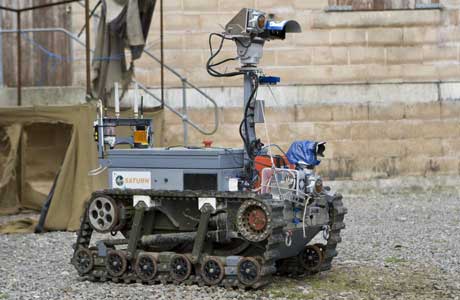
Team Stellar wins the MoD Grand Challenge

Published by The Guardian on 19/08/2008

The Grand Challenge winner, announced today, was Team Stellar – a collaboration of small firms, researchers from Cranfield University and large industrial manufacturers. It beat off competition from 10 other teams whose creations included a swarm of quadropters (helicopters with four rotors), a scaled-down JCB lookalike and a mini flying saucer. The strange collection of craft were taking part in an ambitious competition to develop uncrewed surveillance vehicles that can help the military identify enemy positions in a town or city before sending in troops. The MoD earmarked £4.5m to stage the contest and develop the technologies for the battlefield. The teams competed over three days at Copehill Down, a mocked-up German village on Salisbury Plain that the army uses for training soldiers in house-to-house fighting. Click here for more...

[G.K Comment: What a challenge! It was such a great experience to be working with Team Stellar. Everybody worked incredibly hard, so it's a well deserved victory.]